
How to Provide Students with Feedback

How to Provide Students with Feedback

feedback6Providing feedback is one of the most powerful tools that you can use to transform your students’ learning. But as we all know, sometimes feedback can be negative, causing it to be counterproductive. So how can educators provide effect feedback to students and encourage them to work harder?

Even though there’s no easy way for providing feedback, we generated a list of 4 different ways that you, as an educator, can use with your students.

  1. Be specific with your feedback.

You many think that “Good job!” is a good feedback. But this doesn’t tell your students what they are doing correctly or what they are doing incorrectly. What we suggest to do is try to be specific with your feedback by either focusing on one part of the work or provide your students with information on what they did correctly or incorrectly.


  1. Provide feedback in a timely manner.

The most effective feedback is usually given immediately.  Students who receive feedback immediately respond positively (i.e., better grades). Also, if you give feedback weeks or months later, your students will not remember what they wrote about! Your feedback can be written (i.e., post-it note), verbally or non-verbally (i.e., frown, smile).


  1. Alternate due dates.

If you have a lot of students or classes, this is a great method for you to provide feedback on research projects or tests. By alternating due dates for each students/classes, you can spend more quality time to provide feedback.


  1. Ask students to give YOU feedback.

 That’s right. Have your students give you feedback and be sure to read them! Let them know that they can provide feedback anonymously. Create surveys that allow students to take at home at the end of the school year or semester.  Ask them what they like or dislike about your class, what would they do differently, etc. If you are planning to use a survey for feedback, there are free survey tools, online like SurveyMonkey or SurveyPlanet.

Do you have other methods for providing feedback? Share it with the rest of the Voki community!

Until next time,

Eva D.

The Voki Team

1560505_10152516453053764_8553617582835278394_n

Bio: Eva is the Community Manager for Voki and is part of the Marketing Team at Oddcast. She enjoys playing the piano and knitting on her free time. (She’s also a Rubik’s cube master!) She loves to hear your feedback and comments for Voki!
Tips on Remembering Your Students’ Names

Tips on Remembering Your Students’ Names

School is starting soon and that means a new group of students will be coming into your class! Unfortunately, some teachers might have problems remember names and faces. Let’s face it, if you’re a teacher with 50 (or more) students, you’ll probably have some trouble remembering all their names!

But don’t worry; we have tricks that you use to remember their names! Let’s get started!

Assign seats

On the first day of class, assign your students to seats. Have them sit in the same seats for the first few weeks of school until you are able to remember their names. You can seat them alphabetically; or, you can create a seating chart and post it up on the board.

Make name cards

Making name cards is the easiest way to remember your students’ names. Have your students create name cards and place it on their desk during class. They can also decorate the name cards to make the activity more fun! Before the class ends, collect the name cards. Test yourself the next day by handing out the name cards to you students.

Play a name game

Playing a game is a great icebreaker for a new class. Not only that it is a good way for your new students to get comfortable with the class, it gives them a chance to know each other! Students can come up with an adjective (have to be the same letter as their name) to describe themselves, i.e. Funny Fanny, Silly Sally, Crazy Craig. Each student will have a chance to participate. The first student will give his/her name (along with the adjective. Then the second person will repeat the first person’s student and give his/her name. The third student will recite each name from the beginning and adding their own. The last person to go should be you, the teacher!

What other tricks do you have for remember students’ names? Let us know!

Until next time,

Eva D.

The Voki Team

1560505_10152516453053764_8553617582835278394_nBio: Eva is the Community Manager for Voki and is part of the Marketing Team at Oddcast. She enjoys playing the piano and knitting on her free time. (She’s also a Rubik’s cube master!) She loves to hear your feedback and comments for Voki!

Qualities of a Great Teacher

Qualities of a Great Teacher

Did you have that one teacher who inspired you to go above and beyond? That one teacher who took their time and made sure all his/her students are on the right track? And that one class that you can’t wait to attend? I am sure we can all relate to that.  Teachers carry a huge responsibility in their classroom. They are placed in a position that will shape and mold the future generations and contribute to their students’ successes. Being a teacher isn’t just about spoon-feeding facts and data into student’s brain but about the attitude toward your students and your dedication to your job.

So, we put together a short list of qualities that a great teacher should have. (Keep in mind that this is not all the qualities that are important to being a great teacher.)

Being Organized.

Being organized and prepared is very important. Great teachers are always organized and prepared for class. Their lessons are clearly structured so that students can easily follow it. An organized teacher can quickly find their teaching materials so that there are minimal distractions in class. Besides, what would your students think when you tell them you misplaced all their homework last night? (Maybe “the dog ate your homework” excuse might work!)

 Have Patience.

Patience is a virtue. The most important quality that a teacher should have is patience. A great teacher is very patient with their students and their parents to deal with the same questions and problems over and over again.  You never give up on your students and would try out new ways to help them succeed in school.

Sets High Expectations. 

A great teacher should have set high expectations and work to raise the bar for their students. You should realize that the expectations that you set can greatly affect your students’ achievements. Setting high expectations can help challenge your students to work harder and prepare them for the future. It’s not easy (and they might hate you for it). It is up to you to inspire and encourage them to do their best!

 Cares about Students.

To us, a great teacher should also care about their students. This teacher is the one who students can go to when they have problems/issues or maybe just to share a funny story with! Great teachers are also great listeners and will make time to listen to their students. I’m sure that we all have this one teacher who you talk to after class and you are STILL in contact with him/her today! (Or am I the only one?)

Loves Teaching.

According to Robert John Meehan, “teachers who love teaching, teach children to love learning.” We believe that this is the most important quality that all teachers should have. Teachers should be passionate and love teaching. A teacher who does not enjoy and love their job cannot be effective at all. Also, you can’t expect your students to enjoy the class if you’re not enjoying the class!

We know that there are more qualities that make up a great teacher. What other qualities do you think a great teacher should have? Let us know!

Until next time,

Eva D.

The Voki Team

1560505_10152516453053764_8553617582835278394_nBio: Eva is the Community Manager for Voki and is part of the Marketing Team at Oddcast. She enjoys playing the piano and knitting on her free time. (She’s also a Rubik’s cube master!) She loves to hear your feedback and comments for Voki!


What is a Flipped Classroom?

What is a Flipped Classroom?

imagesMore and more educators are experimenting with flipped classroom. In a traditional classroom setting, the teacher gives a lecture and assigns reading materials and homework questions. Students are required to take notes and they follow instructions given by teachers.
But within a flipped classroom, the lectures and assignments are reversed. This means that lectures/class materials are viewed by students at home before the class and the class-time is devoted to different exercise, hands-on projects and/or discussions. Students can learn at their own pace and receive support from peers and teacher. With a flipped classroom, teachers can be more involved with student learning and provide support to students who need extra practice.

What happens if you’re a first time flipper? The Journal has some very nice tips that you should pay attention to when starting your first flipped class. Some tips for first time flippers are to have a set plan/strategy and start small. If you want to read the entire article, click here.

It might be difficult to try and change your class into a flipped class. Here at Voki, we suggest that you start off small. We are sure that you are already using some form of technology in class (like Voki)! So start off with a technology that you are familiar with and explore different technologies on your free time!

Remember, this is a learning process for you and your students. So just sit back, learn and enjoy it! Have you tried out a flipped classroom, and how is it working out for you? Let us know in the comments below.

Until next time,

Eva D.

The Voki Team

1560505_10152516453053764_8553617582835278394_nBio: Eva is the Community Manager for Voki and is part of the Marketing Team at Oddcast. She enjoys playing the piano and knitting on her free time. (She’s also a Rubik’s cube master!) She loves to hear your feedback and comments for Voki!

Voki Tip of the Week: Voki New Year’s Resolution

Voki Tip of the Week: Voki New Year’s Resolution

It’s hard to believe that 2012 is coming to a close. In preparation for the New Year, have your students come up with some New Year’s resolutions and present them with Voki.

As a fun reminder, ask your students to listen to it again at the end of the school year!

See below for an example:

Happy New Year!

The Voki Team

Hurricane Sandy Update

Hurricane Sandy Update

Hi Voki Fans,

Our office located in Midtown Manhattan lost power last Sunday due to Hurricane Sandy. With power now restored, we will be sure to follow up with any and all emails from the Voki Community ASAP. You may reach us at feedback@voki.com.

Thank you for your patience and a big thank you to those who have been working around the clock to get the region up and running!

Voki Lesson Plans: Holiday Lesson Plans

Voki Lesson Plans: Holiday Lesson Plans

Welcome back to school! To kick off the school year, we have prepared 3 new lessons plans your students are sure to enjoy!

This month’s theme is Holidays! Do you think it’s too early to talk about holidays? Well the folks at Voki don’t! It’s never too early to start preparing lessons for the holiday season.

 Remember: The grade level assigned to each lesson plan is not set in stone. You can use Voki lesson plans for a higher, or lower, grade than the one you teach. Feel free to customize the lesson plans to for your needs. These Voki lesson plans can be adapted to fit your unique style or your students’ abilities!

Halloween – Scary Stories (Middle School) – Students will learn about the history of Halloween, including the origin of trick or treating, costume wearing, and pumpkin carving. In this lesson, students will learn the elements that go into writing a scary story.  Then they will learn how to write their own scary story and share it with the rest of the class.

Thanksgiving Poem (Primary School) In this lesson, students will learn about the origin of Thanksgiving and how the first Thanksgiving was celebrated. They will discuss what they are thankful for and what it means to be thankful. Then, they will write special cinquain poem about what Thanksgiving means to them.

Christmas around the World (Middle School) – Students will learn about the different Christmas traditions and customs from different countries and how it is different from their own tradition. They will discuss about the legend of Santa Claus and the different symbols that represent Christmas.

Want to share your own lesson plans with us? Just send us an email at lessonplans@voki.com!

Until Next Time,

The Voki Team

Voki Lesson Plans: A Day in Ancient Civilizations

Voki Lesson Plans: A Day in Ancient Civilizations

A date with Napoleon? A discussion with Galileo? Escaping Pompeii before the eruption of Mount Vesuvius?

It would be great if we can time travel and learn about the past. We could watch the Titanic set sail on her maiden voyage, go on a field trip to the Roman Colosseum, or even shake hands with George Washington! Wouldn’t that be exciting?

Too bad we can’t time travel, but we can still learn about the past! This month’s theme is Ancient Civilizations and we’ve prepared 3 new lessons plans your students are sure to enjoy!

The Inca Empire – In this lesson, students will learn about the Inca Empire. Students will learn about the Inca geography, government, their laws, and how the Incas travelled. Students will discuss what they would do if they were the Inca Emperor. The class will learn about Inca legends/myths and how it shaped their beliefs. Students will research and create a Voki on an Inca legend/myth.

Ancient Greece – Students will research about the different elements of ancient Greek civilization and how it influenced modern day culture. They will be separated into groups to do research and will create 3 Vokis to present their findings.

Ancient India – This lesson will teach students about the Indus Valley and where it was located. Students will learn about the daily lives of the Indus Valley people lived by doing research. They will use Voki to describe what their life would be like if they lived in the Indus Valley.

 Remember: The grade level assigned to each lesson plan is not set in stone. You can use Voki lesson plans for a higher, or lower, grade than the one you teach. Feel free to customize the lesson plans to for your needs. These Voki lesson plans can be adapted to fit your style or your students’ abilities!

Do you have a lesson plan that you want to share? Just send us an email at lessonplans@voki.com!

Until Next Time,

The Voki Team

Voki Tip of the Week: Singing Voki

Voki Tip of the Week: Singing Voki

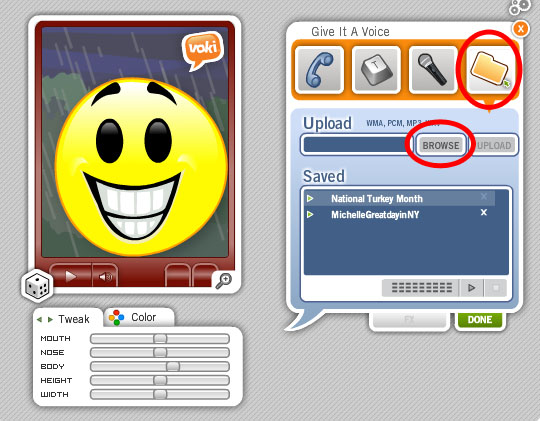
Did you know that you can upload your own audio file? Well, that means you can upload your own audio file to make your Voki sing! It’s a great way to get people to sing along to your songs! But remember, there is a 1-minute recording time for the basic Voki editor. Students can record up to 90 seconds in Voki Classroom.

Follow these easy steps to get your singing Voki!

1. Go to www.Voki.com and create your Voki.

2. Click on the Folder button and Browse for your audio file.

3. Click Upload after you found your audio file.

4. Click the Publish button.

Now your Voki can sing!

Until next time,
The Voki Team

Voki Poet: A Poem by Emily Dickinson

Voki Poet: A Poem by Emily Dickinson

We hope you were able to spend some time this month enjoying poetry in and out of the classroom! Happy National Poetry Month!

Hope is the thing with feathers 
That perches in the soul 
And sings the tune without the words 
And never stops at all.

by Emily Dickinson