Voki Tip of the Week: Voki Classroom – Student Search

Voki Tip of the Week: Voki Classroom – Student Search

It’s difficult to scroll through a list of 100 students! But instead of going through the LONG list, why not just search for their name?

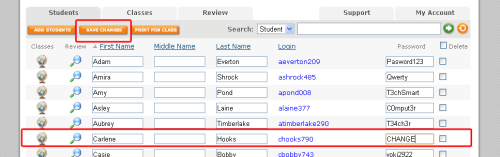
First, click on your Students tab and type in your student’s name. Then hit enter or the green arrow button.

search

Now you can see if your student finished their assignment!


search2

If you have any feedback, questions, or comments for Voki, feel free to send an email to feedback@voki.com!

Until next time,
The Voki Team

Interview with Educators | Stacy Brown

Interview with Educators | Stacy Brown

StacyWe bring you a wonderful interview with Stacy Brown! Stacy is the 21st century learning coordinator from the Davis Academy in Georgia. Stacy is a Voki user since 2010! Her goals in introducing Voki to the Davis Academy are to encourage student engagement, ownership and creativity!

Here are the things Stacy loves about Voki:

  • Voki is very easy to use
  • Voki captures the students’ interest
  • Voki helps integrate technology into the curriculum

Check out Stacy’s full Voki interview here!

____________________________________________________________

Follow Stacy on Twitter: @21stStacy

Want to be interviewed for the Voki blog? Send us an email at submit@voki.com!

Until next time,

The Voki Team

Voki Tip of the Week: Voki Classroom Student Password

Voki Tip of the Week: Voki Classroom Student Password

Student passwords are automatically-generated in Voki Classroom whenever you create a Student account. But did you know that you can change your student’s password?  Your students can even choose their own passwords!

  1. To change your student’s password, find the account that you want to modify.
  2. Change the password here.
  3. Hit the Save button!password2

If you want your student to pick their own password, all you need to do is download the Voki Classroom list template and enter their passwords into the last password column! Download the template here.

password

Then just upload your list to your Voki Classroom account and your students can log into their Student account with their own password!

Have feedback, comments, or questions for Voki? Just send an email to feedback@voki.com!

Until next time,

The Voki Team

Guest Blogger: A Voki Spin on an Old Math Favorite – Jessica Johnston

Guest Blogger: A Voki Spin on an Old Math Favorite – Jessica Johnston

As an Instructional Technology Specialist, I love it when teachers find easy ways to incorporate technology into their everyday lessons.  Technology shouldn’t be separate from what you’re doing in the classroom – it should be woven into what you’re already doing in the classroom.  Voki is a tool that we use in just about every grade level and subject area in my district.  It’s versatile, easy to use, and the kids (and teachers!) love it!

It was no surprise when Staci Stephens, 6th grade math teacher at Brenham Middle School, emailed and asked if I could help her with a Voki lesson in her classroom.  Our school got a new Chromebook cart this year and we were brainstorming ways to use the cart in her math class.  Staci decided to let her kids draw a math problem from the “problem paper bag” – like they had done a dozen times before – but this time they would have to script how they solved the problem.  With a little help from Google Docs, the kids worked through their math problems and typed out every single step.

Normally students would groan about this kind of activity – math AND writing?!  However, when you hold a flashy tool like Voki in front of them, all of a sudden writing about math looks like fun instead of work!  Staci and I were amazed at the detail the students included in their writing and we marveled at the level of engagement and deep thinking that was going on in the classroom.  You could have heard a pin drop – until the avatars started speaking!

Watching the students light up as their writing came to life in the form of a Voki avatar was priceless.  In a single class period, the students had created virtual speaking tutors for dozens of fraction problems.  In the process, not only did they ask meaningful questions about math and writing, but also about technology.  Voki got the students to really THINK about how they solve a math problem, but in a fun and non-threatening way!  Even struggling learners can feel successful with an activity like this.  Here’s what some of the students had to say about this lesson and using Voki:

  • Katherine: I think it helped me because if you are visual learner or you need to hear it it helps you.  You can hear the problem and it helps you work it out.  The Voki was very helpful to all students whether they know it or not.
  •  Rylie: Voki really helped me in Math.  It brought the math problem to life.  I now understand math a lot easier.
  •  Estefania: Well Voki taught me how to cut short sentences for only the important things.  Voki also is very fun to create your own character, to express who you are on your Voki.
  • Jesse: I like Voki because it is fun to do.  It helps me learn because when I hear about stuff it gets stuck in my mind.  It is fun to do because you help other people learn.
  • Arreyus: It’s technology and technology is well known in our century.  It’s fun, but we still learn while having fun.  Voki is a wonderful way for kids in this century to learn things.

Staci published the completed avatars on her teacher website with images of the problems being solved.  Publishing completed work gives the students an audience which makes the learning real and more meaningful.  See the completed avatars here: http://goo.gl/kDjbU.  Here’s what Staci had to say about this lesson:

I like that Voki motivates students to communicate their thinking in a new and exciting way.  Instead of solving 20 addition and subtraction of fraction problems, I learn much more about their problem solving process by having them explain 1 problem step by step.  It is so difficult to hear the voices of each of my students on a daily basis, especially my shy students, but Voki enables each student to explain what they were thinking without the fear often involved with speaking up in class.  I’m a big believer that learning mathematics is more than just solving problems- it is a problem solving process, but often when I ask students to write about or explain the process my students are very hesitant.  Generally, they do not like writing, and do not feel they are good writers, but Voki gives them a way to communicate their thinking in a way they enjoy!
If you are looking for an easy (and FREE!) tool to use with any age students in any content area, I can highly recommend Voki and I know my staff and students would say the same.  Brenham ISD loves Voki and I am certain your organization will, as well!
__________________________________________________________________________

For Jessica’s blog, go here: EdTechChic

Follow Jessica on Twitter: @EdTechChic

Like Jessica’s Facebook page: EdTechChic Facebook

 

Interview with Educators | Stephanie Bullock

Interview with Educators | Stephanie Bullock

This week we have an interview with Mrs. Stephanie Bullock. Mrs. Bullock is an academic technology teacher from The Lovett School in Atlanta, GA. She a Voki user since 2009! It was great that we have a chance to talk to Mrs. Bullock.

Here’s what Mrs. Bullock likes about Voki:

  1. My students feel like they are creating something original and personal to share with a wider audience.
  2. I love that my students can create their own backgrounds to further personalize their Vokis.
  3. My most favorite thing is that Vokis are easily embeddable and they are there for me to share with the students’ family.

Mrs. Bullock created a Voki about how she used Voki in class. She and her third graders did a really great reading project by creating Voki characters to represents the characters from the books they read!

Q: What would you add to the Voki product?

A: I would add the ability to edit the student Vokis from the teacher account. My students were too young and my time with them was too limited to ask them to handle the audio conversions that were necessary, so I had to keep track of all their usernames and passwords in order to add the audio for them. It was time consuming.

Wider variety of acceptable voice and background formats. I’ve had to open students’ backgrounds using Preview and then export them as low-quality .jpgs in order for them to successfully be uploaded.

The ability to publish a Voki without having to add audio so that the students’ work during one computer class period will be saved for the next time they have class. I haven’t found a way to save their work before they are ready to add audio. (See my work-around below).

Q: Do you have any Voki tricks up your sleeve?

A: I use the application Audacity to convert audio files to the acceptable .mp3 format.  My students only have access to the application Audio Recorder on their computer, producing an .m4a file that isn’t an acceptable file type.

To circumvent the publishing issue that I have, I usually type in a filler word like “test” in the audio component to Voki so that I am able to save students’ work from class period to class period.

_______________________________________________________________________________

Mrs. Bullock runs a technology blog: http://techknowledgey.edublogs.org/

Follow Mrs. Bullock on Twitter: @srbullock

Want to be interviewed for the Voki blog? Send us an email at submit@voki.com!

Until next time,

The Voki Team

Voki Lesson Plans: Lunar New Year Lesson Plans

Voki Lesson Plans: Lunar New Year Lesson Plans

Lunar New Year is coming up! Lunar New Year is a very important holiday in Asia. To celebrate this upcoming holiday in Asia, we have prepared 3 new Lunar New Year lesson plans on Korea, China, and Vietnam.


Remember:  You can use Voki lesson plans for a higher, or lower, grade than the one you teach. These Voki lesson plans can be adapted and customized to fit your unique style or your students’ abilities!

Chinese New Year –   Students will learn about the legend behind Chinese New Year and the 12 animal zodiacs. They will look into the customs and traditions of Chinese New Year and how it is celebrated. Students will learn Chinese New Year greetings. They will create a Voki to compare and contrast New Year and Chinese New Year.


Korean New Year (Seollal) This lesson will teach students the Koreans celebrate Lunar New Year. They will learn about traditional New Year’s food and how to play a traditional New Year’s game. Students will learn how to wish others Happy New Year in Korean.


Vietnamese New Year (Tet) – In this lesson, students will learn how the Chinese influenced Vietnamese culture. They will learn about the preparations before and during Tet. They will compare and contrast Vietnamese New Year (Tet) with their own holidays and holiday traditions. Students will split up into groups to research on 3 different aspects of Tet.

If you have a lesson plan that you want to share with us, send it to lessonplans@voki.com!

恭喜發財!

새해복많이 받으세요!

Chúc Mừng Nǎm Mới!

The Voki Team

Interview with Educators | Angelyn Cheatham

Interview with Educators | Angelyn Cheatham

It’s been a while since we had an interview with a teacher! This week we are featuring Angelyn Cheatham and her favorite Vokis! Angelyn is an elementary technology integration specialist for Garland ISD in Texas. She trains teachers and students on how to use technology tools.

Here are some of the reasons why Angelyn loves Voki:

  1. Engaging for students to use
  2. Safe way to publish student work without identifying faces
  3. Allow students to communicate their messages
  4. Can be integrated into any subject areas
  5. Intuitive for even the youngest students

If you can’t view Angelyn’s Prezi here, click the picture below to open the link!

angel

_____________________________________________________________

Angelyn runs a technology blog: Great ‘Tech’pectations.

Follow Angelyn on Twitter: @AngelynCheatham

Want to be interviewed for the Voki blog? Send us an email at submit@voki.com and we’ll get in touch!

Until next time,

The Voki Team

Voki Tip of the Week: Voki Book Report

Voki Tip of the Week: Voki Book Report

Are you planning to assign a book report? Why not add a twist with Voki! Instead of a traditional book report, have your students create a Voki about the latest book they read.

Check out our example here:

Send an email to feedback@voki.com if you have any questions, comments, or feedback!

Until next time,

The Voki Team

Voki Tip of the Week: Review Classroom Rules and School Rules

Voki Tip of the Week: Review Classroom Rules and School Rules

It’s a new year and after a long break, your students may have forgotten about the rules in the classroom and at school! Create a Voki to remind them of all the do’s and don’ts.

Check out the example here:

If you have any feedback, comments, or questions, send an email to  feedback@voki.com!

Until next time,

The Voki Team

Guest Blogger: Karen Nemeth – Digital Storytelling

Guest Blogger: Karen Nemeth – Digital Storytelling

By Karen Nemeth

www.ecetech.net

Have you ever read a word and assumed it was pronounced one way, and then you finally heard someone say the word and pronounce it differently? Then you realize you’ve been hearing it incorrectly in your head?  When you read, it would be easy to think that though and through rhyme, but if that’s what you thought, then when your teacher asks you to write down another word for ‘toss’, you might write “through” instead of “throw”.   Oral language is a very important component of early literacy.  Young children need to say words and hear word sounds to build their vocabulary and to create a foundation for reading and writing.  Technology can play a key role in supporting the connection between oral language and written language.  That’s why voice recording and digital story-telling programs can be valuable tools for early literacy education.  With fun and engaging activities, some serious learning can actually be taking place.

With digital storytelling, children can create their own stories and images and they can record their own voice saying the words.  Think of this as an enhancement of the traditional preschool or kindergarten learning activity when a teacher reads a story to the children then asks them to retell the story in their own words.  With a program such as Voki, children have to think ahead about what they will say and how they want to illustrate it.  They have to practice pronouncing the words and then hearing them back as they play their recorded messages. That’s great oral language practice!.

Now consider how this activity could be a great support for young children who are just beginning to learn English as a new language.  Children who are learning a second language can often be shy or embarrassed about pronouncing the new words.  Rather than asking them to speak aloud in front of the whole class, it’s a good idea to use an app or website that allows them to record their own voice and listen back to the recording to hear how they sound to others.  The teacher can even save the child’s recordings to document their progress.  Another great use of Voki would be to have a parent, volunteer or other staff member record or trade messages with the new dual language learner (DLL) in their home language.  What a welcoming and comforting experience that can be for a new DLL.

Language in the context of brief stories or meaningful interactions makes the strongest connections in a child’s brain.  Rather than have the child practice with random vocabulary words, consider having them record Voki messages that will serve a purpose.  Can they record a message to be shared with their parents?  Can they record a message describing a pattern of beads for stringing and then share with a friend to see if they can duplicate the pattern?   Can they record clues for a treasure hunt? Or can they let the pre- recorded message on Voki become part of a   pretend play scheme?  The possibilities are endless and the value of supporting oral language practices to support literacy and reading success is limitless!

These ideas and more can be found in my book, Digital Decisions: Choosing the Right Technology Tools for Early Childhood Education.  You can share your teaching ideas on the Voki.com website.

Karen Nemeth is the author, with Fran Simon, of Digital Decisions: Choosing the Right Technology Tools for Early Childhood Education.  Karen and Fran share lots of related resources on their website www.ecetech.net.  Karen is also a nationally known speaker and author on teaching young children who are dual language learners.